Robots that clear the food court tray return.
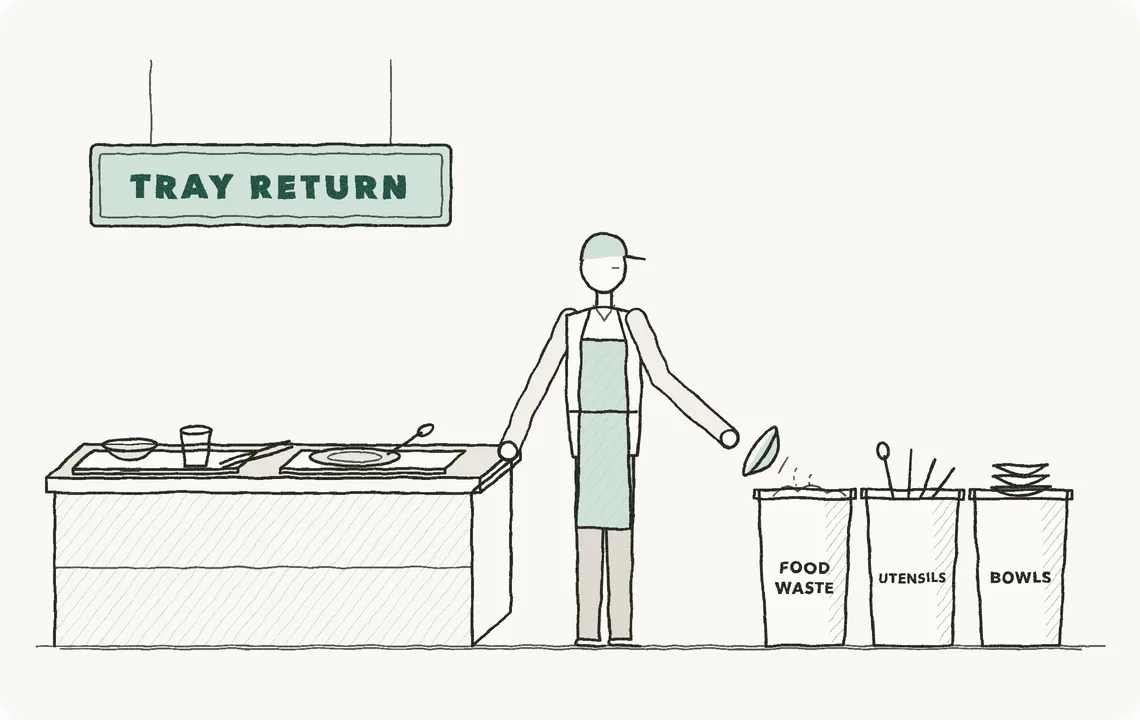
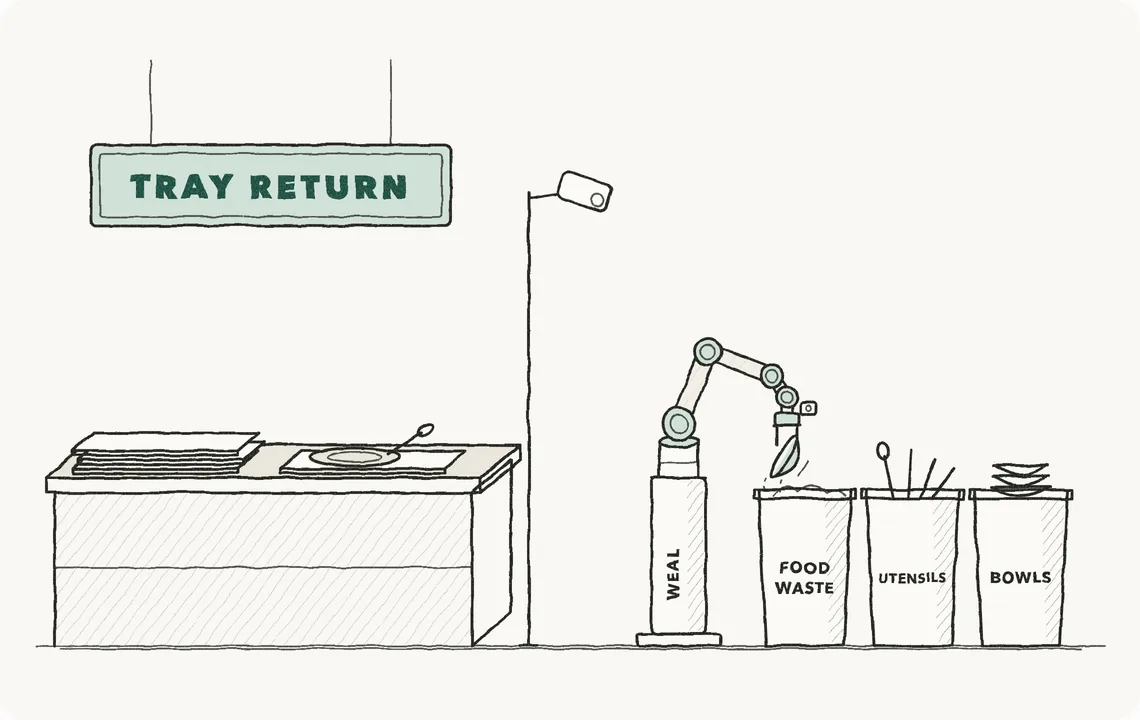
Tray return is one of the most repetitive, hardest-to-staff jobs in a food court. Our robot arm takes it over: it clears each returned tray, tips leftover food into the waste bin, and sorts bowls and utensils.
Targets for our pilot robots. Throughput depends on how many items are on each tray.
Discuss a pilotSee how it worksHow it works
Only the middle step changes. Diners do what they do today, and your staff keep handling bins, now for the robot instead of for themselves.
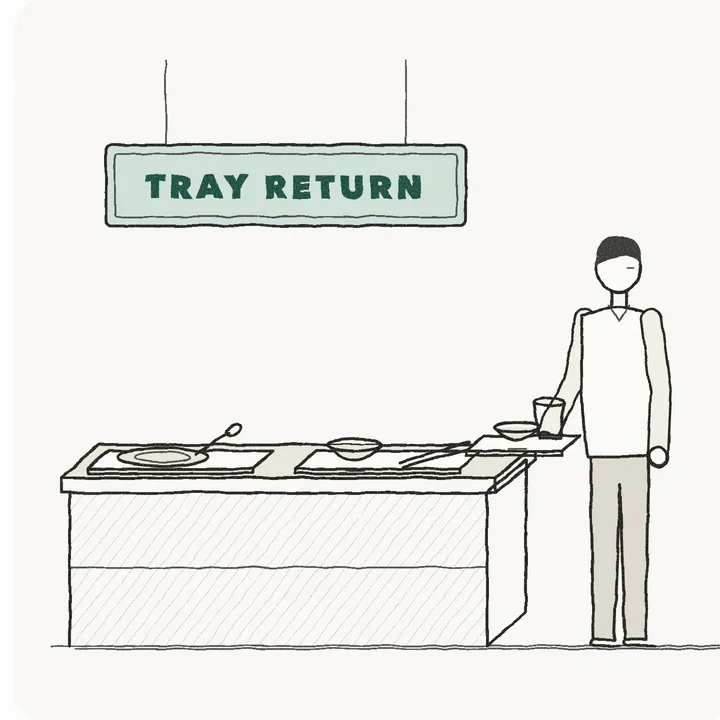
Return trays as usual
Diners leave their trays at the tray return counter. No new habits, no new signage.
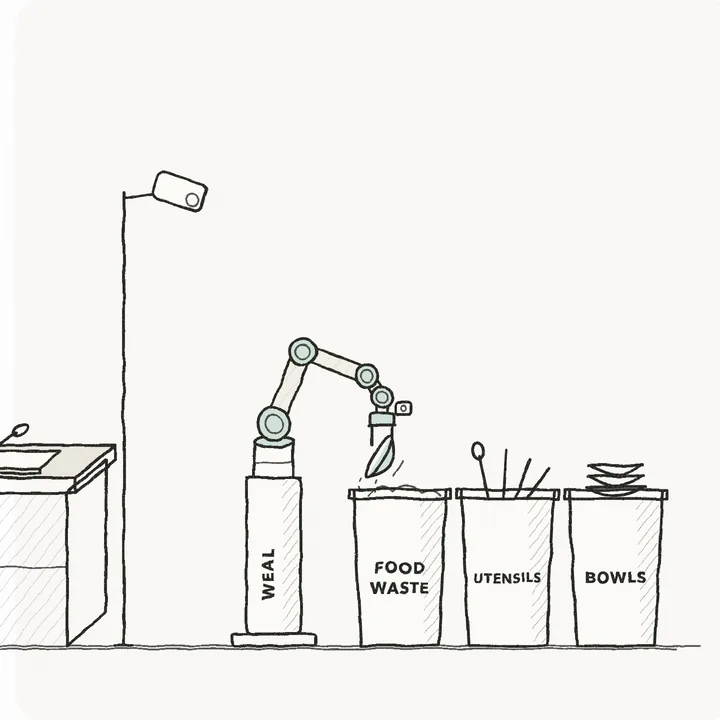
Clears and sorts every tray
The work your staff do by hand today: the arm takes each tray, tips leftover food into the waste bin, and sorts bowls and utensils into their own bins.
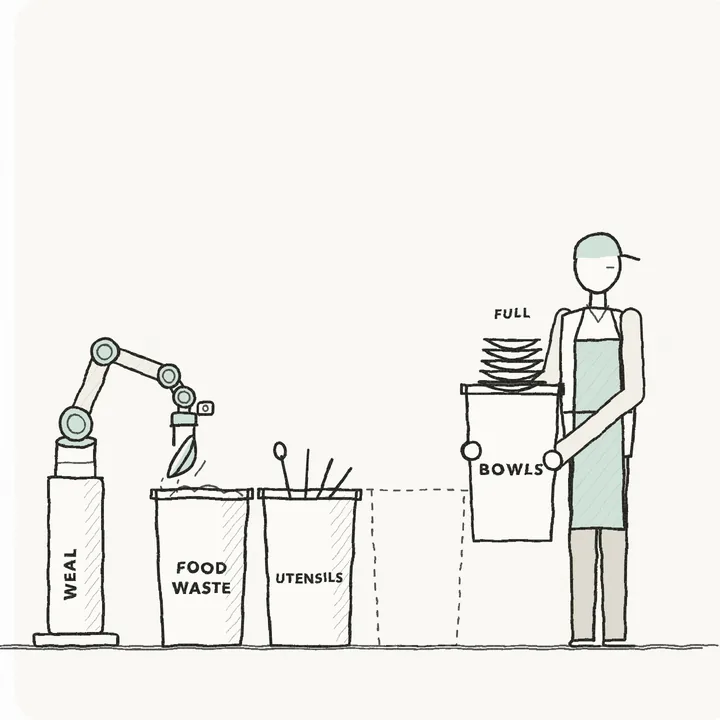
Swap full bins and send them to washing
Same: staff swap out full bowl, utensil and waste bins and take them to the dishwashing room, as they do today.
Different: the robot is on a fixed base, so staff swap its bins for it, and step in on the rare tray it can't handle.
Who we serve
We partner with cleaning companies that run food court tray returns. At first, one of your staff assists the robot on site. Our target: one person looks after three robots, doing the work of three.
More sites, same team
The robot covers the most repetitive station, so your staff can cover more of the site and you can take on more contracts.
Fewer hard-to-fill roles
Tray return is one of the hardest positions to staff. A robot that works every shift reduces your reliance on it.
You stay in charge of the site
We supply and support the robot. You keep the client relationship and run the site as you do today.
Technology
Our robots run on a vision-language-action model: a large AI model that sees through cameras and directly controls the arm. At each new site it first learns your trays, bowls and layout, then works on its own.
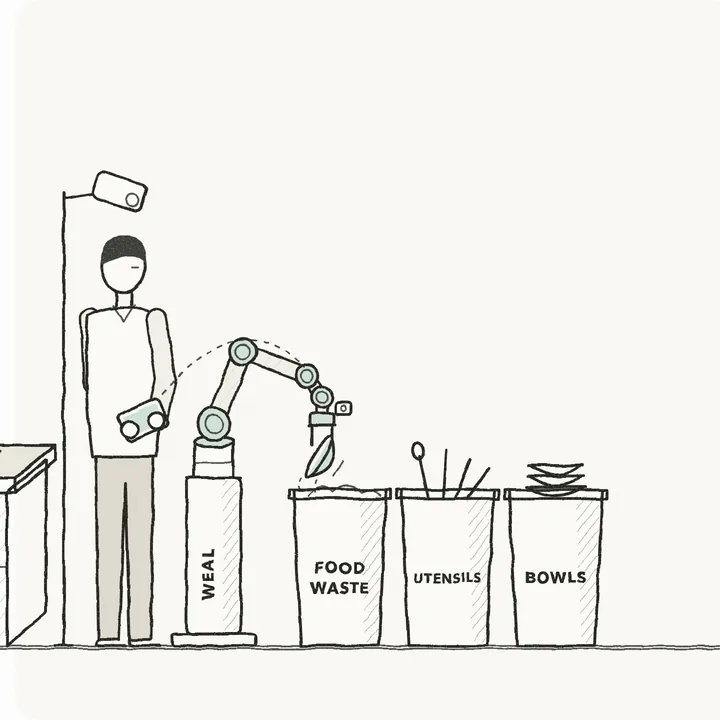
Our operator teaches the robot
The robot works the tray return while a Weal operator stands by. When it gets something wrong, the operator takes over and corrects it, and that correction becomes training data. Your staff don't need to do anything extra.
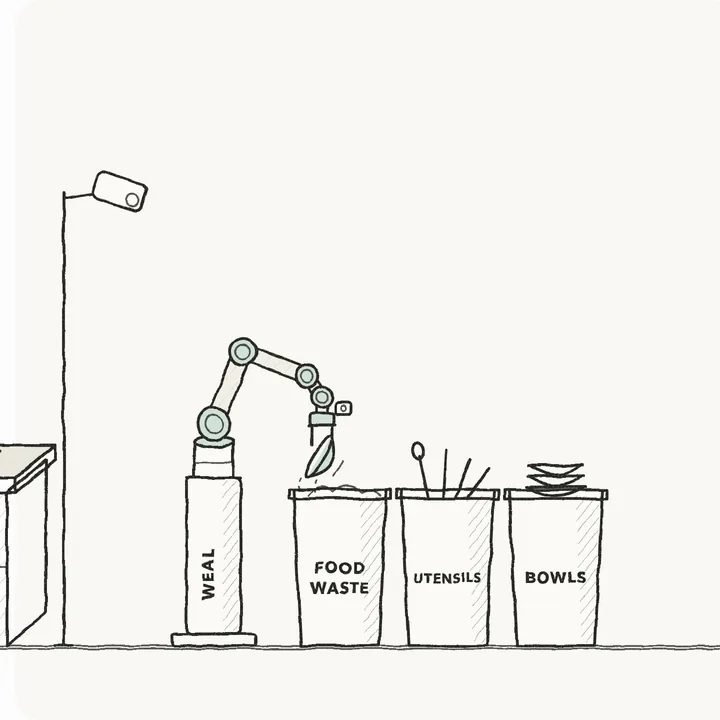
The robot runs on its own
Once it reaches our standard, the operator leaves and the robot works by itself, seldom needing help. Our target: human speed, and fewer than one intervention in every twenty trays.
Pricing
One monthly fee. No surprises.
- The robot is included. No upfront purchase.
- Covers the AI that runs it, plus all maintenance and support.
- If something needs fixing, we fix it.
Pricing depends on your site's tray volume. Ask for a quote →
Questions
How much space does it need?
About one standing space: 80 × 60 cm. The counter and bins sit around the arm.
What power does it need?
A standard wall socket. The arm, its computer and an LED work light draw about 200 W in normal use and stay under 300 W at peak.
Is it safe around people?
The robot is bolted to a fixed base and never moves around the site. Its reach is limited to the counter and bins that surround it, which act as a safety margin.
How many trays can it handle at once?
5 to 6 trays on a flat counter within its reach. It doesn't work with multi-level tray shelves yet, and it can't reach trays placed outside its range.
Will we still need staff?
Yes, but fewer. During the pilot, one staff member assists on site. Our target is one person looking after three robots. Staff also keep swapping full bins and taking them to washing.
How long does installation take?
Half a day. The robot then spends its first 2 to 3 weeks learning your site with a Weal operator on hand.
What happens if it breaks?
Maintenance and support are included in the monthly fee. If something needs fixing, we fix it.
How long is the contract?
It matches your cleaning contract with the food court, typically 1 to 2 years. Pilot terms are flexible.
About
Jiabin Qin, founder
Before Weal, Jiabin was Head of Product at Neuron Mobility, the Singapore-founded e-scooter sharing company, where he led the team that built Neuron's e-scooter. Neuron raised over US$77 million and runs fleets across Australia, New Zealand, Canada, the UK and Asia, and has since merged with Beam.
At Weal, he builds the robot system end to end: collecting robot data, fine-tuning the latest robot foundation models with human-in-the-loop corrections, and deploying them on real arms. See some of our robot data.
Run a pilot at your site
We're starting pilots with a small number of cleaning companies in Singapore. Tell us about your site.
WhatsApp +65 8445 9212hello@wealrobotics.com